Project Overview
Gladstone Regional Council engaged South-East Scanning to undertake a comprehensive, two-stage subsurface and structural investigation across the Gladstone Leisure Centre. The project required a complete ground-penetrating radar assessment of the external pavements, followed by a detailed GPR scan of the twenty-five-metre indoor pool. Council’s goal was to build a clear understanding of structural performance, subsurface conditions, and any issues that may be contributing to functional or temperature-related challenges within the aquatic facility.
Stage One: External Pavement Investigation
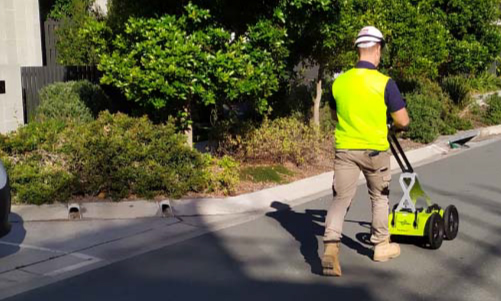
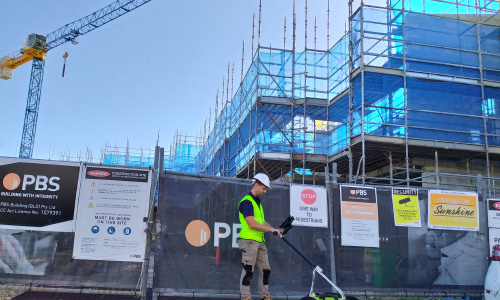
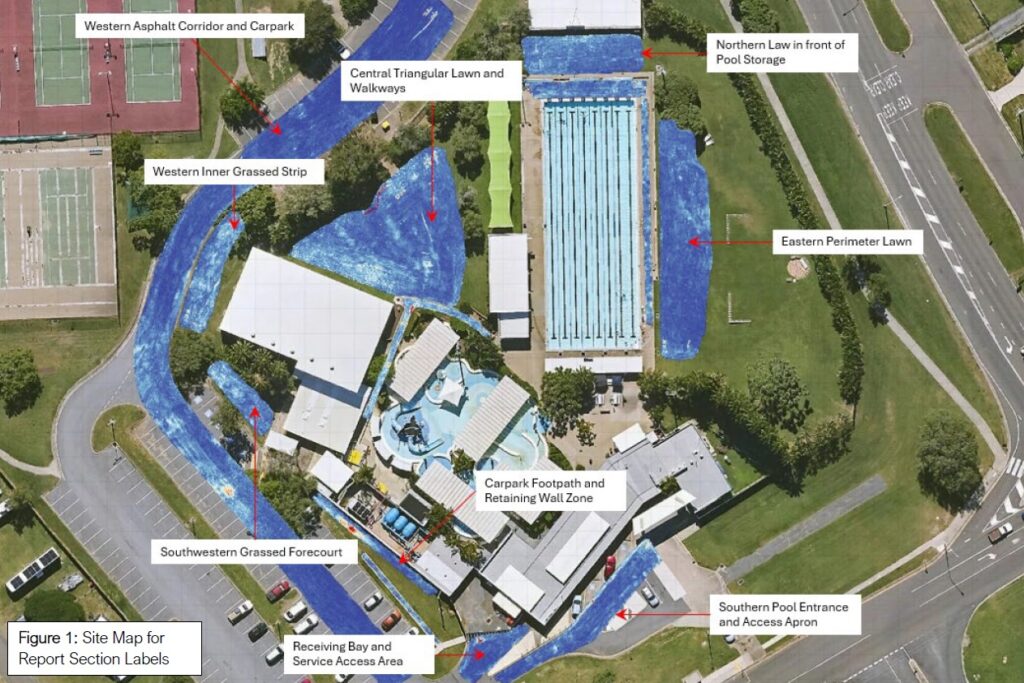
The outdoor component of the investigation focused on large-scale scanning of the concrete apron and the surrounding pavement. Using the MALA Mira Compact system, South-East Scanning completed a full-coverage grid across the external slabs, capturing high-resolution B-scans and assembling depth slices that enabled assessment of structural behaviour over a wide area. The conditions were challenging, with the work carried out in peak North Queensland heat. Still, the Mira produced exceptionally clean datasets, which Geolitix later processed to build an interpretable structural map of the site. The review confirmed consistent slab behaviour across most of the external pavement, with no evidence of slab separation, buried voids, or subsurface collapse that could impact the centre’s infrastructure. Localised features such as conduits, backfill transitions, and reinforcement patterns were also identified and recorded for the Council’s asset team.
Stage Two: Indoor Pool Structural Scan
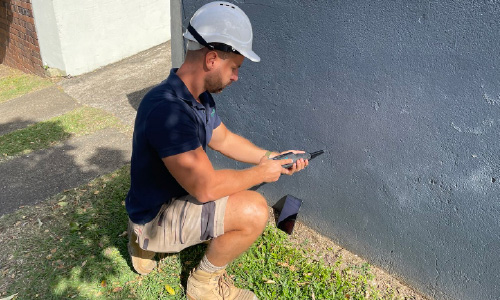
The second stage of the project required an in-depth scan of the twenty-five-metre indoor pool, which had been exhibiting irregular temperature behaviour and lacked accurate as-built documentation. South-East Scanning deployed the Impulse Radar PinPointR to perform a dense, orthogonal grid across the entire pool floor, using both 400 MHz and 800 MHz frequencies to penetrate the full shell depth. The indoor environment enabled highly controlled data collection and produced exceptionally detailed C-scan imagery. Additional thickness checks were completed with the Proceq GP8000, and reinforcement confirmation was undertaken with the Profometer PM8000 to anchor interpretations on calibrated data.
Findings: Indoor Pool Structural Integrity
The indoor pool scan revealed a structurally coherent and continuous concrete shell. Reinforcement was present across the entire floor, with spacing patterns tightening through the central deepening of the pool, consistent with expected structural behaviour. The concrete ribs supporting the shell appeared as strong, continuous reflectors in the radar data and displayed no indication of cracking, separation, or weakening. Across all depth slices, the pool floor showed no signs of voiding, washout, delamination, or undermining beneath the tiles. The concrete matrix read as dense, uniform, and well-bonded.
Notable Subsurface Features
Two subsurface features identified inside the pool warranted attention even though they did not indicate structural failure. A pronounced longitudinal reflector running along the middle of the pool suggests an embedded service or pipe, and a high-amplitude zone along the eastern perimeter aligns with external subsurface features identified during the outdoor scan. Neither of these behaved like internal defects, and both were interpreted as external or service-related anomalies rather than structural issues.
Combined Interpretation and Temperature Concerns
Together, the indoor and outdoor datasets provided a clear mechanical picture of how the facility is performing. The outdoor scan ruled out significant subsurface instability around the structure, and the indoor pool scan confirmed the shell is structurally sound, properly reinforced, and free from internal voids. As a result, South-East Scanning concluded that the temperature irregularities are unlikely to originate from failures within the concrete shell itself. More probable causes include boundary conditions along the eastern side of the building, variations in the surrounding backfill or subsurface materials, or issues with mechanical, heating, or circulation systems rather than the pool structure.
The Conclusion of South East Scanning's GPR Invvestigation of Gladstone Leisure Centre
Together, the indoor and outdoor datasets provided a clear mechanical picture of how the facility is performing. The outdoor scan ruled out significant subsurface instability around the structure, and the indoor pool scan confirmed the shell is structurally sound, properly reinforced, and free from internal voids. As a result, South-East Scanning concluded that the temperature irregularities are unlikely to originate from failures within the concrete shell itself. More probable causes include boundary conditions along the eastern side of the building, variations in the surrounding backfill or subsurface materials, or issues with mechanical, heating, or circulation systems rather than the pool structure.
Contact South East Scanning Today For A Consultation About Your Commercial Subsurface Scanning Needs