When you need to see what’s hidden inside concrete — rebar, conduits, voids or post-tension cables — two non-destructive testing methods are commonly used: Concrete X-ray (radiography) and Ground Penetrating Radar (GPR). Both reveal subsurface features without cutting or core-drilling, but they work very differently and suit different jobs. This post explains how each technology operates, their strengths and limitations, costs and safety considerations, and practical guidance on which to choose for common construction, renovation and inspection tasks.
How Each Method Works
Concrete X-ray (radiography)
Concrete X-ray (radiography) uses ionising radiation — typically gamma rays from a radioactive isotope like Iridium-192 or an X-ray generator — to penetrate concrete. A detector (film or digital panel) is placed on the opposite side of the slab or wall. Materials that absorb radiation (steel, dense objects) show up as dark areas on the image, creating a 2D projection of the internal elements along the beam path.
Ground Penetrating Radar (GPR)
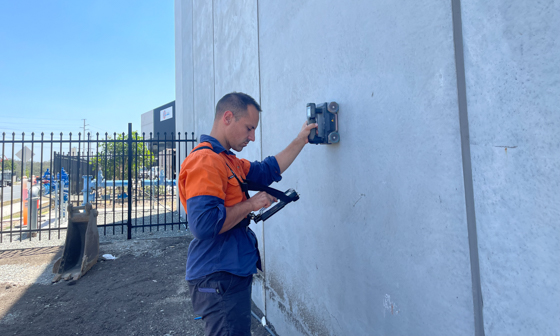
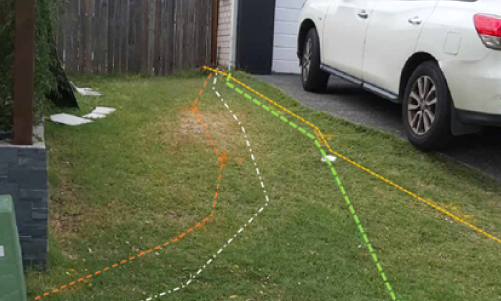
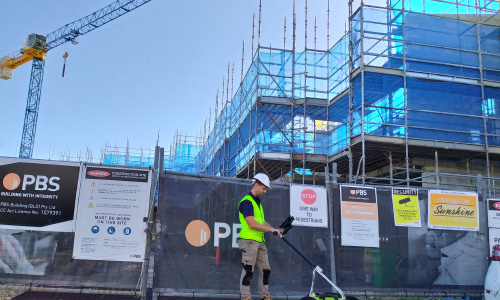
Ground Penetrating Radar (GPR) emits short pulses of electromagnetic waves into the concrete using an antenna. When those waves encounter interfaces with different dielectric properties (steel vs concrete, voids, moisture changes), part of the signal reflects back and is recorded. GPR produces a series of radar traces that can be assembled into 2D or quasi-3D profiles showing the depth and horizontal position of anomalies.
Key Differences At A Glance
- Type of data
- X-ray: 2D projection image (like a flat photograph) — great for clear images of steel and dense objects along the beam line.
- GPR: Reflection profiles that give distance/time data convertible to depth — good for mapping over an area and locating objects in plan and depth.
- X-ray: 2D projection image (like a flat photograph) — great for clear images of steel and dense objects along the beam line.
- Penetration depth
- X-ray: Can image through thick concrete depending on source strength and exposure; limited by safety considerations.
- GPR: Typically up to a few metres in concrete, but practical depth depends on frequency, concrete composition and moisture.
- X-ray: Can image through thick concrete depending on source strength and exposure; limited by safety considerations.
- Resolution
- X-ray: Very high spatial resolution for objects on the beam line.
- GPR: Resolution depends on antenna frequency — higher frequency = better resolution but shallower penetration.
- X-ray: Very high spatial resolution for objects on the beam line.
- Safety
- X-ray: Uses ionising radiation — strict safety controls, exclusion zones and licenced operators required.
- GPR: Non-ionising and safe to operate with minimal site restrictions.
- X-ray: Uses ionising radiation — strict safety controls, exclusion zones and licenced operators required.
- Speed and coverage
- X-ray: Slower and usually used for targeted inspections (one beam at a time).
- GPR: Faster for scanning larger areas and creating maps of reinforcement layouts.
- X-ray: Slower and usually used for targeted inspections (one beam at a time).
When X-ray Is The Better Choice
High-resolution imaging of rebar or fixings across a narrow line. Because X-ray provides crisp, high-contrast images of steel, it’s excellent when you need a detailed look at a specific zone — for example, to confirm spacing and overlapping of rebar or to inspect welds and couplers.
When penetration through very thick, dense concrete is required. With appropriate source strength, X-ray can image through thicker sections that might challenge GPR.
Situations where electromagnetic reflections are ambiguous. If the concrete contains lots of aggregates, voids, or moisture variation that confuses radar signals, X-ray can sometimes give a clearer picture.
When GPR Is The Better Choice
Mapping reinforcement across large areas. GPR can rapidly scan slabs, floors and walls to produce plan maps of rebar layout, making it the go-to for site surveys and pre-cutting checks.
Depth estimation and locating non-metallic features. GPR can detect voids, channels, ducts and changes in material properties that X-ray won’t show because those items don’t attenuate radiation strongly.
Safer and more flexible on occupied sites. Since GPR doesn’t use ionising radiation, it’s easier to deploy in public or occupied spaces and doesn’t require exclusion zones or a radiation safety officer.
Limitations To Be Aware Of
X-Ray
- Health and regulatory burdens — requires trained, licenced personnel and strict controls.
- Only a 2D projection — overlapping objects along the beam can obscure each other.
- Slower and more logistically complex for large areas.
Benefits of Using Concrete Radar
- Interpretation requires experienced operators — reflections can be ambiguous and false positives occur.
- Performance degrades in very wet concrete or where conductive materials (salts, high moisture) reduce signal penetration.
- Lower absolute spatial resolution compared with radiography for very fine features.
Cost and logistics
Costs vary widely by region, job size and access, but some general points:
- X-ray tends to be more expensive per inspected location because of equipment, licencing and time needed to set up exclusion zones. It’s commonly hired for targeted investigations.
- GPR is usually more cost-effective for scanning larger areas, as a single operator can survey metres of slab per hour and produce a map that informs cutting or coring decisions.
Always ask for itemised quotes that list mobilisation, reporting, interpretation time and any traffic or access management charges. For safety and liability reasons, reputable operators should provide a clear scope, risk assessment and calibration records.
Practical tips for choosing the right method
- Define the objective. If you need a detailed picture of a specific junction, coupler or overlapping bar, X-ray may be preferable. If you need a plan of reinforcement across a slab or to find non-metallic voids/ducts, choose GPR.
- Consider site access and occupation. If the area is publicly accessible or difficult to isolate, GPR’s safety advantages are significant.
- Ask about operator experience and deliverables. Good GPR scans come with annotated plan views and depth estimates; X-ray delivers high-contrast photos. Make sure the report format meets your needs (CAD overlays, PDF with marked locations, etc.).
- Combine methods when necessary. Sometimes the best approach is a hybrid: use GPR to map an area quickly, then X-ray targeted locations where you need higher certainty.
Conclusion
Both Concrete X-ray and GPR are powerful non-destructive testing tools, but they serve different purposes. X-ray delivers high-resolution 2D images ideal for targeted investigations of steel and dense objects, at the cost of regulatory complexity and safety controls. GPR offers flexible, safe, and fast area mapping with depth information and the ability to detect non-metallic anomalies, though it requires interpretation skill and can be sensitive to moisture and material composition.
For most construction and renovation projects where you need a broad picture of reinforcement and subsurface features, start with GPR. If you then require definitive, high-resolution confirmation at a specific point, follow up with X-ray. That pragmatic, staged approach usually balances cost, safety and the level of certainty clients need before cutting, coring or installing new services.
Ready to plan your renovation or extension with confidence? Partner with an experienced concrete radar provider to ensure safe, efficient, and successful projects every time.