Structural Integrity
Assessment of
Noosa Blue Resort Pool
What is the true condition of an ageing concrete pool before refurbishment begins? For Noosa Blue Resort, the answer required more than a visual inspection — it required a full non-destructive investigation of the pool shell's internal structure.
The Project
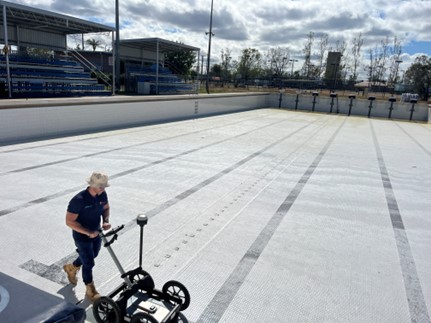
The project at Noosa Blue Resort focused on a practical question — what is the true condition of an ageing concrete pool before refurbishment begins? The structure had been drained and exposed for some time, providing an opportunity to properly assess the pool shell before any works were approved.
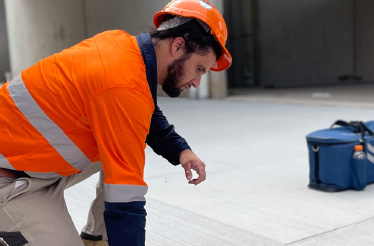
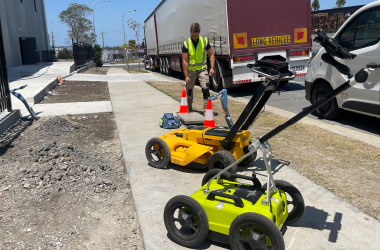
This was not just a visual inspection. South-East Scanning was engaged to undertake a non-destructive structural assessment incorporating multiple complementary testing techniques: ground penetrating radar scanning to identify reinforcement layouts and concrete cover depths, rebound hammer testing using a Proceq Silver Schmidt to provide an indicative assessment of compressive strength, and surface moisture assessment to evaluate the drained shell's current condition.
The goal was to understand the internal structure — including reinforcement layout, concrete thickness, and overall material condition — to assist the project engineer and pool builder in assessing the pool shell's suitability for refurbishment or modification works. The pool is of a free-form configuration with varying depths and includes a locally thickened base section within the deep end.
Reinforcement Layout
Ground penetrating radar scanning played a central role. It allowed the team to assess the internal makeup of the concrete without any destructive testing. Early in the investigation, a well-defined reinforcement system was identified.
The base slab contained two layers of longitudinal reinforcement running along the length of the pool toward the deep end. The upper longitudinal reinforcement layer was located at approximately 75 mm concrete cover, with a secondary deeper reinforcement layer detected at approximately 100 mm depth. Longitudinal reinforcement spacing was measured at approximately 200 mm centres.
A single transverse reinforcement layer running across the width of the pool was detected at an approximate concrete cover of 100 mm, with an average spacing of approximately 150 mm centres. For a structure of this age, that level of reinforcement was a strong starting point.
Further scanning revealed additional reinforcement in the deeper section of the pool, particularly within the circular bowl. This detail was important, as it showed the original design had accounted for increased structural demand in this area — consistent with reinforcement placed to support the curved formwork geometry of the deeper bowl.
The pool walls were found to contain vertical reinforcement bars at approximately 200 mm centres and horizontal reinforcement bars at approximately 300 mm centres. Concrete cover to wall reinforcement ranged between approximately 100 mm and 120 mm — generally higher than typically observed in residential pool construction.
| Element | Layer / Direction | Cover Depth | Spacing |
|---|---|---|---|
| Base Slab | Longitudinal — upper layer | ~75 mm | ~200 mm centres |
| Base Slab | Longitudinal — secondary layer | ~100 mm | ~200 mm centres |
| Base Slab | Transverse (single layer) | ~100 mm | ~150 mm centres |
| Deep-End Bowl | Additional reinforcement (circular) | — | Curved formwork support |
| Pool Walls | Vertical bars | 100–120 mm | ~200 mm centres |
| Pool Walls | Horizontal bars | 100–120 mm | ~300 mm centres |
Concrete Thickness
Concrete thickness provided further confidence. The base slab measured around 200 mm in most areas, increasing to approximately 300 mm in the deep end. This variation aligned with expected load conditions — consistent with typical structural detailing used to resist hydrostatic and soil loading in deeper pool geometries — rather than random construction differences.
The pool walls were also consistent, measuring around 300 mm thick and supported by both vertical and horizontal reinforcement grids.
Surface Hardness & Material Strength
Material strength was assessed using rebound hammer testing across multiple locations using a Proceq Silver Schmidt rebound hammer. A total of twenty-six valid rebound readings were recorded with an average rebound value of 43.5 Q and a standard deviation of 5.6 Q.
Lower values were generally associated with impacts on the exposed pebblecrete finish, while readings taken on exposed concrete paste consistently returned higher rebound values between approximately 50 Q and 60 Q. Based on typical rebound correlations, the results are consistent with concrete likely meeting or exceeding the project target strength of 25 MPa, and potentially within the range of 30 to 40 MPa equivalent compressive strength. For an existing structure, this is a solid result.
Rebound hammer testing provides an indicative measure of surface hardness only and cannot be used as a definitive determination of compressive strength. Confirmation of in situ compressive strength would require extraction and laboratory testing of concrete core samples.
Moisture Content
Moisture levels were also assessed, which is often overlooked in similar investigations. Surface moisture testing returned readings between 2.8% and 3.2%, confirming that the pool shell had dried out effectively after being drained, with no indication of trapped moisture or internal deterioration. These values are consistent with a drained pool shell that has been exposed to environmental drying for an extended period.
Observed Surface Condition
Visually, the pool showed signs of ageing, as expected. However, these were cosmetic rather than structural concerns. Visual inspection identified isolated areas of deterioration within the pebblecrete finish layer, including localised delamination and previous patch repair locations.
One area of surface repair showed rust staining in the finish layer, likely due to moisture migration through the repair mortar and surface aggregate. However, no reinforcement exposure, reinforcement displacement, or structural cracking associated with reinforcement corrosion was detected during the investigation.
Minor cracking was observed along sections of the pool expansion joint. No structural movement or displacement of reinforcement was detected in the radar data in these locations.
The Outcome
So what did it all point to? The pool shell was structurally sound. Reinforcement was well distributed, thickness was sufficient, and material strength was consistent. While refurbishment would be required to address surface condition, there was no indication that major structural remediation or replacement was necessary.
In practical terms, this is the best-case outcome. Rather than a costly rebuild, the project could move forward with targeted refurbishment, backed by clear and defensible data.
- Robust dual-layer longitudinal reinforcement confirmed in base slab — no structural deficiencies detected
- Concrete thickness sufficient throughout — 200 mm base slab, 300 mm deep end and walls
- Rebound hammer results consistent with ≥25 MPa — meeting or exceeding project strength target
- Moisture readings 2.8–3.2% — shell fully dried, no trapped moisture or internal deterioration
- Surface defects cosmetic only — pebblecrete delamination and patch repairs, no structural corrosion
- No reinforcement displacement, exposure, or structural anomalies detected during investigation
- Client cleared to proceed with targeted refurbishment — no costly rebuild required
Limitations
Ground penetrating radar identifies changes in subsurface electromagnetic properties and is highly effective at locating embedded metallic reinforcement. The technique does not directly measure the reinforcement diameter, and interpretation depends on signal clarity and concrete cover depth.
Rebound hammer testing provides an indirect measure of surface hardness and cannot be used as a definitive measure of compressive strength. Where precise strength values are required, concrete core extraction and laboratory compression testing must be undertaken.