
Not All Concrete Cracks Mean the Same Thing
Cracks in concrete are common — but some are superficial, and others indicate a deeper problem. Shrinkage, thermal movement, and minor settlement are expected over time. Reinforcement corrosion, loss of subgrade support, moisture-related deterioration, overloading, and structural movement are not.
The challenge for engineers and project managers is knowing the difference before committing budget to repairs, demolition, or invasive investigation. South East Scanning provides detailed concrete crack assessments using non-destructive testing methods — giving you a clearer understanding of what is happening beneath the surface, the level of risk present, and the proportionate next steps.
Unlike a basic visual inspection alone, our assessments combine surface observations with ground-penetrating radar, reinforcement mapping, concrete cover assessment, slab thickness analysis, moisture review, and screening for subsurface anomalies. The result is a far more informed basis for decision-making — especially when the crack pattern is unclear, the asset is high-value, or the consequences of getting it wrong are significant.
No obligation — most assessments are quoted within 24 hours.
Concrete Crack Assessment Case Studies & Field Investigations
These case studies demonstrate the value of combining visual assessment with non-destructive testing to reach a defensible conclusion — rather than guessing based on surface observations alone.
Slab Moisture & Efflorescence Assessment
A systemic investigation into persistent cracking, efflorescence, and moisture ingress at a residential concrete slab — combining GPR, impedance testing, and CCTV drainage analysis to identify external moisture drivers and subgrade instability as the root cause.
Read the Case Study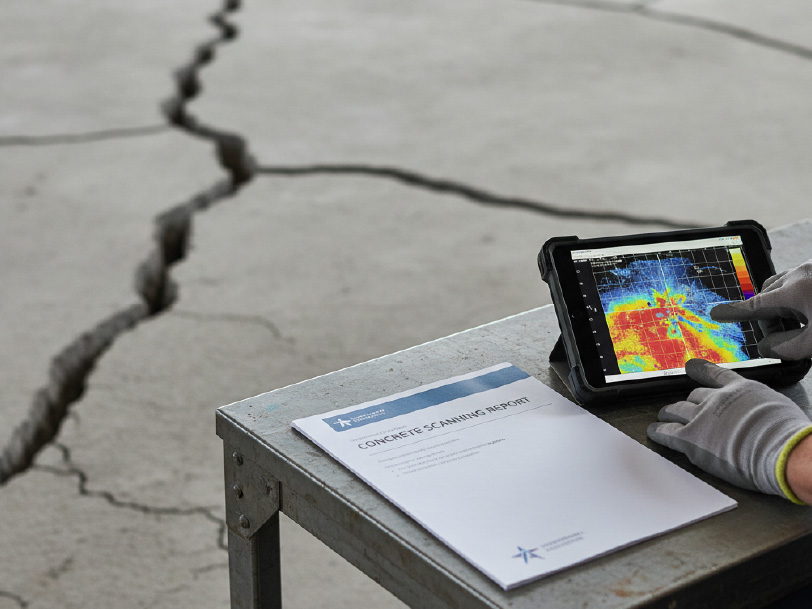
GPR Reveals Hidden Risks in Concrete & Asphalt
At Marion Creek Bridge, GPR scanning identified multiple layers of asphalt overlay and anomalies invisible to visual inspection — demonstrating how NDT protects against unseen structural risk before maintenance or repair work proceeds.
Read the Case StudyWhat's Included in a Concrete Crack Assessment
Scope is determined by the asset type and the nature of the concern. Assessments are tailored to give you the information that is actually relevant — without unnecessary investigation or cost.
Visual Crack Assessment
Identification, classification, width and length recording, pattern assessment, and photographic documentation of all visible cracking.
Reinforcement Mapping
GPR-based identification of reinforcement layout, bar spacing, and depth — establishing whether cracking aligns with or cuts across reinforcement.
Concrete Cover Assessment
Measurement of cover depth to reinforcement — low cover is a known contributor to corrosion-related cracking and long-term durability issues.
Slab Thickness Analysis
Determination of slab thickness and identification of inconsistencies — relevant where cracking may relate to variations in construction.
Voiding & Loss of Support
Screening for subsurface voids or loss of subgrade support — a common driver of cracking that is not visible at the surface and cannot be assessed by visual inspection alone.
Moisture & Delamination
Assessment of moisture ingress and delamination where these are relevant to the cracking mechanism or to the intended repair scope.
We can assess cracking in ground slabs, suspended slabs, walls, footpaths, retaining walls, precast elements, and other reinforced concrete structures. Our reports also include a clear limitations section — so you understand both what was found and what falls outside the scope of non-destructive testing.
Understanding Concrete Crack Patterns & Failure Mechanisms
Crack orientation, width, displacement, and surrounding context all contribute to understanding mechanism. We do not simply label a crack and move on — we assess the surrounding structural context, reinforcement arrangement, and subsurface data to build a complete picture.

Often associated with shrinkage or thermal movement. Generally lower concern when displacement is absent and reinforcement is intact, but context always matters.

May suggest differential settlement or foundation movement. Diagonal pattern, direction, and rate of progression are key indicators in the assessment.

Often the most concerning crack type — may indicate lateral pressure, corrosion-related issues, or significant structural loading. Warrants careful assessment of the reinforcement condition and cover depth.

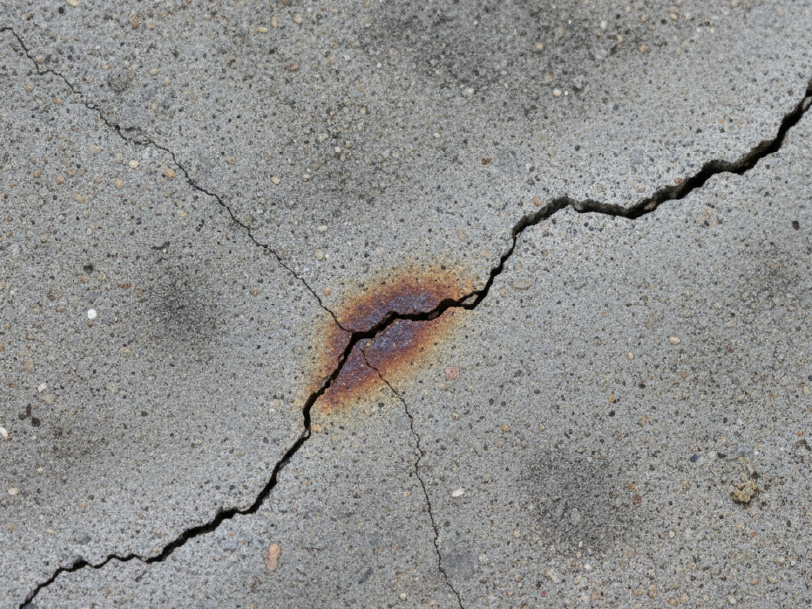
Frequently follows reinforcement layout and may be associated with thermal restraint, corrosion-driven expansion, or differential movement. Rust staining adjacent to longitudinal cracks is a strong indicator of reinforcement deterioration.
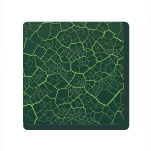
Often cosmetic — associated with surface drying or alkali-silica reaction — but context matters. Where map cracking is combined with displacement or unusual surface condition, further investigation is warranted.

Step cracking may suggest foundation or subgrade movement. Displacement across the crack face — where one side is elevated relative to the other — is a key indicator that warrants greater concern and subsurface investigation.
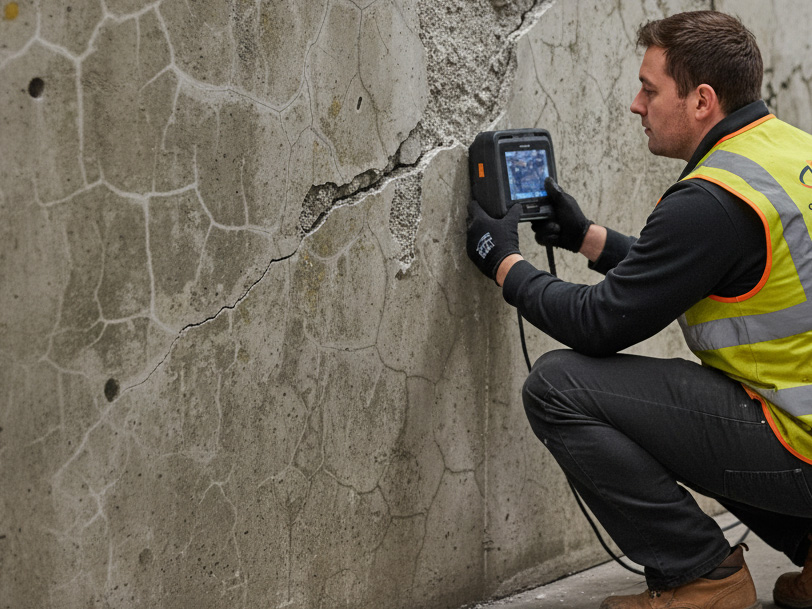
 GPR Scanning — In the Field
Non-Destructive Testing Gives A Better Answer
A crack at the surface does not reveal what is happening underneath. Ground-penetrating radar allows us to assess reinforcement layout, cover depth, and slab thickness, while also screening for anomalies such as potential voiding, loss of support, inconsistent signal returns, or areas of high attenuation.
In one previous assessment, a longitudinal crack in a cold room slab was investigated using non-destructive testing. The assessment confirmed structural continuity, no evidence of voiding, delamination, or loss of support, and reinforcement consistent with typical construction. Cracking was most likely related to thermal cycling and restraint from embedded reinforcement — not structural failure or subgrade instability.
That is the value of doing it properly. It allows engineers and asset owners to respond proportionately rather than assuming the worst.
When to Book a Concrete Crack Assessment
Our concrete crack assessment service is suited to professionals who need clarity before deciding on repair, monitoring, or escalation.
- Engineers and project managers requiring independent, defensible data
- Builders and remedial contractors preparing for repair or refurbishment
- Body corporates, strata managers, and facility managers with unexplained cracking
- Asset owners where there is disagreement about cause or concern about liability
- Commercial property managers and councils needing to document condition before further works
Particularly well-suited to warehouse slabs, suspended slabs, driveways, footpaths, retaining walls, industrial floors, apartment buildings, and other reinforced concrete structures.
Concrete Crack Assessment Reports You Can Act On
Clients receive a clear, written report documenting the observed cracking, the testing undertaken, the subsurface findings, the likely mechanism based on the available evidence, and practical next-step recommendations.
Our reports are designed to be useful in the real world — clear photographs, concise explanation, defensible observations, and practical recommendations rather than vague language.
Recommendations may include:
- Monitoring and re-inspection at a defined interval
- Crack sealing or surface treatment where appropriate
- Targeted destructive verification of specific areas
- Further engineering review where warranted
- No immediate action, where the evidence supports that position
What Makes Our Concrete Crack Assessments Different
South East Scanning offers concrete crack assessments as a specialist diagnostic service — not just an add-on to scanning work. We have built our approach around understanding the mechanism of cracking, not simply recording that a crack exists.
 GPR Crack Investigation
Concrete Crack Assessment FAQs
Everything engineers, builders, and asset owners commonly ask before commissioning an assessment.
NDT can confirm reinforcement layout, cover depth, slab thickness, the presence or absence of subsurface voiding, areas of potential delamination, and moisture-related anomalies in the concrete. It also provides a systematic record of visible cracking — orientation, width, length, pattern, displacement, and associated indicators. What NDT cannot definitively confirm is load capacity, concrete compressive strength, or the exact extent of reinforcement corrosion — those require destructive or electrochemical methods. Our reports make this distinction clearly, so you have an accurate picture of what has and has not been determined.
Most concrete crack assessments are completed in a single site visit. Duration varies depending on the area to be assessed, the number of elements, and the scope of testing — a typical residential or small commercial slab assessment takes two to four hours on site. Reports are generally delivered the same day or the following business day, allowing your project to keep moving. Where the scope is larger or the findings require more detailed interpretation, we will advise on timeframes at the time of quoting.
We can assess cracking in ground slabs, suspended slabs, concrete walls, retaining walls, footpaths, driveways, precast elements, industrial floors, bridge decks, and other reinforced concrete structures. If you are unsure whether the structure is suitable for NDT assessment, contact us and we can advise on the most appropriate approach for your specific situation.
A structural engineer assesses structural performance and provides professional engineering opinion. Our service is a non-destructive testing consultancy that provides subsurface data — reinforcement layout, cover depth, voiding, slab thickness, and anomaly screening — that a visual inspection alone cannot provide. These services are complementary. In many cases, our assessment provides the data that an engineer needs to form their opinion without resorting to destructive investigation. We can work alongside your structural engineer, or our findings can be provided to them to inform their assessment.
No. In fact, an assessment is often most valuable before cracking worsens or before repair work is commissioned — because it establishes the likely mechanism and baseline condition. Cracking that appears stable may still indicate underlying reinforcement corrosion, subgrade instability, or other deterioration mechanisms that are best identified and documented early. The goal is to understand the cause, not just to monitor the symptom.
Yes. Our reports are structured to be defensible and clearly documented — they record the date of inspection, the scope of testing, the methods used, the findings, the limitations, and the technician's observations. They are regularly used in the context of insurance assessments, building defect disputes, body corporate claims, and pre-litigation documentation. South East Scanning holds full professional indemnity and public liability insurance, and our reports are produced to a standard that supports their use in formal proceedings where required.
If the assessment identifies indicators that warrant concern — such as evidence of significant reinforcement corrosion, potential voiding, or loss of subgrade support — our report will clearly describe what was found, what it may indicate, the level of confidence in that interpretation, and the recommended next steps. This may include further targeted destructive investigation, engineering review, monitoring, or immediate remediation depending on the severity of the findings. We will not overstate uncertainty, and we will not understate a genuine risk.
We operate across South East Queensland including Gold Coast, Brisbane, Ipswich, Sunshine Coast, and the Fraser Coast region. We also service Central Queensland, North Queensland, and Western Queensland. If your project is outside these areas, contact us to discuss availability — we regularly travel for larger projects or where the scope warrants it.
