A residential property in Gympie, Queensland presented with persistent moisture problems affecting a concrete garage slab. The owner had noticed ongoing efflorescence — white salt deposits forming on the surface — along with staining, cracking, and moisture that continued to return despite previous repair attempts. South East Scanning was engaged to conduct a comprehensive, non-destructive concrete slab investigation to identify the root cause and determine whether the issue originated internally within the slab or was being driven by external factors. What the investigation uncovered was a systemic problem with multiple contributing sources — none of which had been addressed by prior surface-level repairs.
From the first site visit, it was immediately clear that this was not an isolated or localised defect. The slab presented with a widespread pattern of distress rather than a single point of failure — an important early indicator that the underlying cause was broader in nature.
Efflorescence
White salt deposits were visible across the slab surface. Efflorescence occurs when water migrates through concrete and carries soluble salts to the surface, leaving deposits as it evaporates. Its widespread presence confirmed active, ongoing moisture movement through the slab.
Widespread Cracking
A network of cracks was identified across multiple areas of the slab. These are not merely cosmetic — surface cracks act as pathways that allow moisture to travel upward through the concrete body, compounding the efflorescence and staining observed at the surface.
Surface Staining
Discolouration and staining across the slab corresponded closely with areas of highest crack density. This pattern is consistent with moisture that is not just sitting on the surface but actively migrating upward from below the slab — a sign of pressure-driven ingress rather than surface condensation.
 Surface Distress — Efflorescence, Staining & Cracking
A multi-method approach was used to build a complete picture of the slab's condition and the broader site factors contributing to the problem. Using a combination of techniques rather than relying on any single method ensured that both the internal and external causes could be identified with confidence.
Visual Inspection
A thorough visual assessment of the slab surface, surrounding ground, retaining walls, and drainage infrastructure was conducted. This established the full extent of visible distress and identified site conditions that may be contributing to the moisture problem.
Moisture Testing
Moisture readings were taken at multiple points across the slab using calibrated testing equipment. Results were mapped to identify the distribution of elevated moisture levels and their correlation with areas of visible cracking and staining — confirming that moisture was actively migrating upward through the slab rather than condensing at the surface.
Ground Penetrating Radar (GPR)
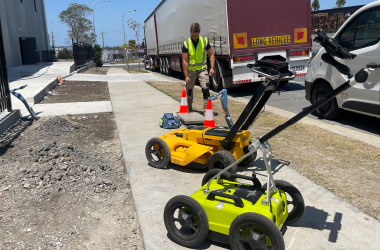
GPR scanning was used to assess the internal condition of the slab without any destructive investigation. The scan identified variations in slab construction including inconsistent reinforcement depth and areas of reduced structural integrity. Critically, the data also indicated possible voids or loss of support beneath sections of the slab — pointing to underlying ground instability as a contributing factor to slab movement and the irregular cracking pattern observed at the surface.
CCTV Drainage Inspection
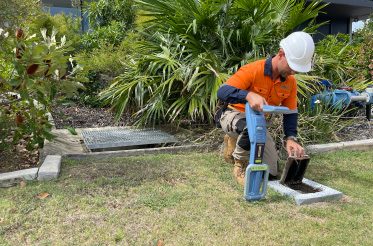
The stormwater drainage system serving the property was assessed by CCTV inspection. A damaged section of drainage pipe was identified that was not functioning as designed. Rather than directing water away from the structure, the pipe was discharging into the surrounding soil — creating persistently saturated ground conditions immediately adjacent to and beneath the slab.
Possible Voids Beneath the Slab
GPR data indicated areas of potential void formation or loss of ground support beneath sections of the slab. This type of subsurface instability is consistent with soil that has been persistently saturated and weakened over time — and directly explains the irregular cracking pattern visible at the surface. Without addressing the ground conditions, surface repairs will continue to fail.
The investigation made clear that the slab's condition could not be understood in isolation. Several site-level factors were working together to sustain and worsen the moisture problem — and all of them needed to be recognised before any remediation plan could be meaningful.
The combination of a damaged drainage system discharging into the soil and poor site grading had created a situation where the ground surrounding and beneath the slab was persistently saturated. Over time, this saturated soil weakened, causing subsidence and slab movement — which in turn produced the irregular cracking pattern observed at the surface. The damaged retaining wall nearby was a further indicator that this moisture-driven ground instability was not confined to the garage area.
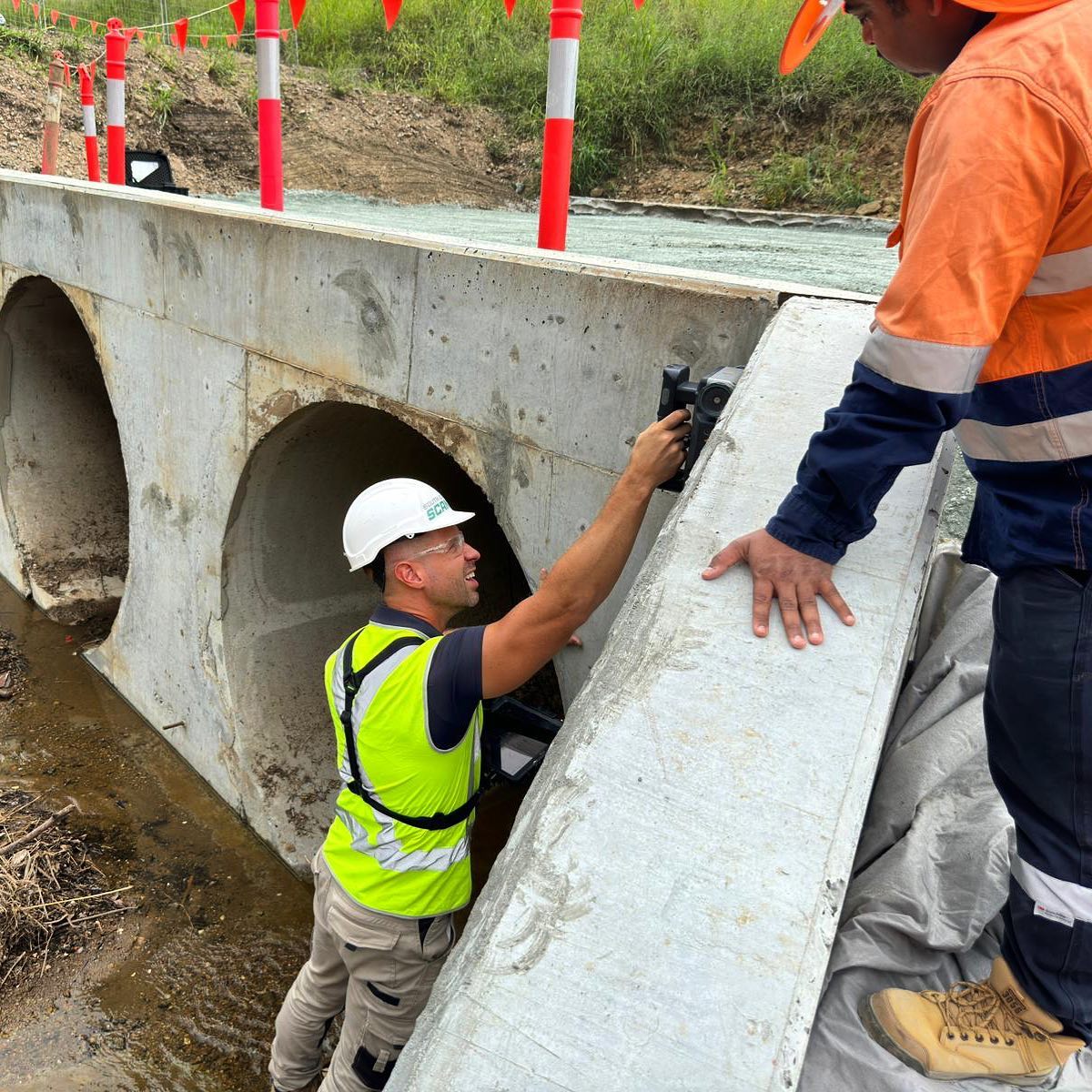 GPR Scanning — Subsurface Analysis
 On-Site Results — Gympie Investigation
A key finding of this investigation was that previous repair attempts — including epoxy crack injection — had not resolved the problem and had not been expected to. Surface treatments address symptoms rather than causes. When moisture continues to infiltrate from beneath and around the slab, any sealing or patching at the surface is temporary at best. The moisture finds new pathways, new cracks form, and efflorescence returns.
Epoxy crack repairs, surface sealers, and cosmetic treatments cannot stop moisture that is being driven upward through the slab by hydrostatic pressure from saturated ground below. Until the source of moisture ingress is removed, surface repairs will continue to fail.
This is why a thorough, multi-method investigation is so important before committing to any remediation strategy. Without understanding what is actually driving the problem, property owners risk investing repeatedly in repairs that provide only temporary relief.
The findings confirmed that this was a systemic issue driven primarily by external moisture ingress and inadequate site drainage. Accordingly, the recommended remediation approach focuses entirely on the root causes rather than the surface symptoms.
Priority Remediation Actions
- Repair and reinstate the damaged stormwater drainage pipe to ensure water is properly directed away from the structure and surrounding soil.
- Improve site grading and surface drainage to prevent water accumulation adjacent to the garage slab.
- Investigate and stabilise subsurface ground conditions where GPR indicated possible void formation or loss of support beneath the slab.
- Repair and reinstate the damaged retaining wall to restore soil containment and reduce ongoing moisture exposure to the surrounding ground.
- Re-evaluate the slab condition following drainage and ground stabilisation works — only then can the extent of any required slab repair be accurately determined.
Without addressing these underlying factors first, any further surface treatment of the slab — whether crack injection, sealing, or resurfacing — will provide only temporary relief. Moisture ingress and progressive slab deterioration are likely to continue until the drainage and ground stability issues are fully resolved. For structures where structural investigation and analysis is required alongside moisture assessment, a coordinated approach between scanning specialists and structural engineers produces the most complete picture.
This Gympie case study illustrates a pattern that South East Scanning encounters regularly — a property owner dealing with recurring moisture problems that have resisted multiple repair attempts, because the underlying cause has never been properly identified. The combination of GPR scanning, moisture testing, and drainage inspection provided a comprehensive, evidence-based picture of what was actually driving the problem: a failed stormwater system, persistently saturated ground, possible subsurface voids, and inadequate site drainage working together over time.
Understanding the full picture before committing to remediation is what separates effective, lasting repairs from costly cycles of temporary fixes. Whether you're dealing with moisture issues, unexplained cracking, or a slab that has required repeated attention, a professional concrete slab inspection using non-destructive methods is the right starting point. You can also read more about hidden risks in concrete slabs and how early detection prevents escalating damage.
Get a Free Quote Today