Safe drilling and slab clearance at Woolworths retail using GPR concrete scanning — in-store drilling works and fence installation on a suspended slab, delivered as one programme for the same client.
GPR Scanning at
Woolworths
Retail Sites
A small mistake can cause serious damage or downtime when drilling into concrete in an active supermarket. For 345 Projects, we cleared concrete across Woolworths retail floors — in busy trading areas and at a fence line on a suspended slab — locating reinforcement, conduits, PT tendons, and embedded services before any cutting or coring.
The Challenge
In-store drilling: high-traffic Woolworths floor areas. Fence / suspended slab: concrete scanning prior to fence installation. Both scopes under one programme for 345 Projects — typical of supermarket trading floors and perimeter works where the slab is still live.
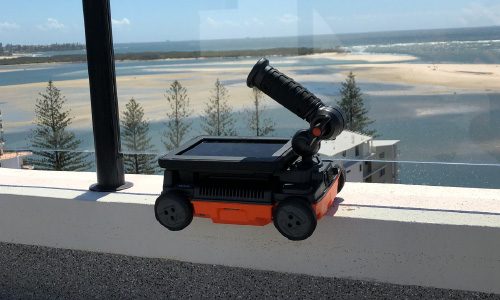
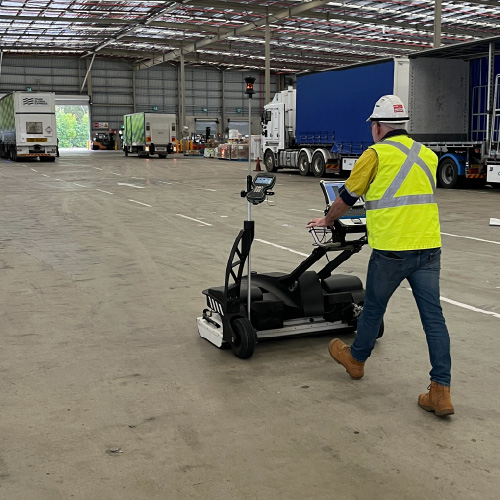
On paper, the in-store drilling scope looked straightforward. In an active Woolworths, it carried real risk: locate hidden services in the slab, confirm safe drilling zones, and keep trading going. The goal was to see reinforcement, conduits, and anything embedded before a bit touched concrete. Ground penetrating radar surveys ran across multiple areas using the GSSI StructureScan Flex NX — a common choice for non-destructive concrete inspection. From the outset the focus was simple: reduce risk before physical work started.
For the fence line, the brief was different but the principle the same: concrete scanning combined with electronic locating is the best practical way to clear a slab for cutting or coring. Technician Marc Ogg carried out the fence-line survey on 2 February 2026 at 09:19 with the Proceq GP8000, with slab dielectric recorded at 6.15. Client contact: Ethan (345 Projects).
What We Found
In-store drilling areas. During scanning, two electrical conduits appeared inside anti-shoplifting zones — the sort of detail teams miss without proper investigation. Both sat directly on the reinforcement mesh, so drilling without marks could have damaged them. No post-tension cables or live power showed in the scanned areas, which removed a major risk layer — but nothing was assumed. Slab depth checked out at roughly 150–160 mm and reinforcement spacing was confirmed before safe zones were marked. Reinforcement distribution varied across the slab, which is typical in retail and underlines why scanning beats guesswork. Near customer exit routes, electrical service runs were picked up, marked, and tied back to the reinforcement layout; risk there was classified as low and drilling could proceed inside the designated zones.
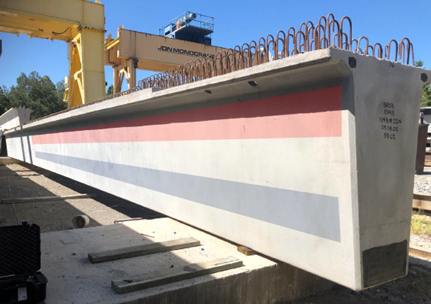
Fence line — suspended slab. GPR on the suspended slab indicated about 200 mm thickness, reinforcement at 200 mm centres, and roughly 40 mm cover, with two reinforcement layers. Post-tension tendons were marked in orange; low-voltage services for existing gate infrastructure in pink. Survey summary (primary location): slab depth 200 mm, reinforcement 200 mm, services and PT cables reported yes, beams/footings no, risk profile medium. Data quality: average. No cracks or voids identified during scanning.
How We Worked
That level of clarity removes guesswork and helps keep programmes moving without avoidable delays. This is where jobs often go wrong: scanning is skipped to save cost, or teams rely on old drawings. In practice, slabs change and undocumented services are more common than people expect.
On the fence slab, PT tendons and gate-related low-voltage services were marked on the concrete, medium risk at the surveyed location was communicated before work started, and the report spelled out what GPR can and cannot promise. In the in-store drilling areas, exit-zone services were marked to the reinforcement layout with low risk at those points. Reports also set expectations: not every embedded service can be guaranteed found — slab thickness, signal interference, closely spaced conduits, toppings, waterproofing (including foil barriers), and passive vs energised cable detection all affect results. As with all embedded services, reasonable effort applies in the nominated area; critical services (e.g. fire alarm circuits) may need extra coordination. Findings are risk-reduction intelligence and should be read alongside drawings and engineer verification where structural decisions are involved.
The Outcome
- In-store drilling completed safely — no service strikes, no unexpected interruptions, no damage to structure or embedded systems
- Two conduits in anti-shoplifting zones marked; exit-area services marked with low risk; no PT or live power in scanned drilling areas
- Fence slab: PT tendons marked orange; gate low-voltage services marked pink; slab ~200 mm, 2× reo @ 200 mm, ~40 mm cover confirmed
- Fence survey: primary location risk medium, communicated to 345 Projects; scan data quality average; no cracks or voids in scan
- Overall programme: scanning supported confident, controlled execution for the installation team
Report & Scan Limitations
GPR and electronic locating reduce strike risk but cannot guarantee every object in concrete will be found. Small or deep bars, shadowing behind reinforcement, slab thickness, toppings, waterproofing (foil can block the signal), and conduit spacing can all limit what appears on data.
Marked targets need a buffer (often ≥25 mm either side); scanning within ~100 mm of walls and corners may need access from both sides. Stop work if unexpected metal filings appear or water loss occurs where it should not. Do not drill beyond roughly 20% over reported slab thickness without reassessment. Structural interpretations in reports should be confirmed by a qualified engineer where required.