Reading A Wet Slab:
GPR And Moisture Mapping
Beneath A Coastal Building
For a coastal council building showing long-term cracking and mould, South East Scanning combined ground-penetrating radar with surface moisture mapping across seven locations — separating genuine subsurface distress from drainage-driven moisture, without a single core hole.
A building doesn't need to be falling down to be worth investigating properly. At the Norfolk Island Tourist Centre in Burnt Pine, the signs were more modest but persistent: cracking in the slab, patches of elevated moisture, and mould that kept returning no matter how many times it was treated. Norfolk Island Regional Council needed to understand what was actually happening beneath the floor before committing to any remediation, structural assessment, or floor finish decision.
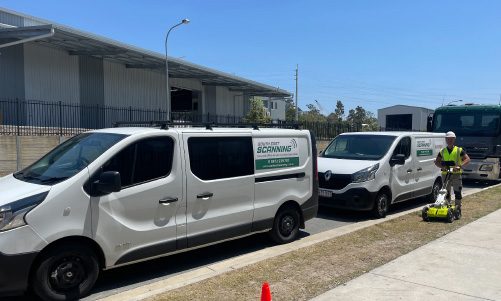
South East Scanning carried out a non-destructive investigation combining ground-penetrating radar with surface moisture testing and a visual inspection of the slab and building perimeter. The aim was not simply to find moisture — moisture readings alone rarely explain why a slab is behaving the way it is. The aim was to work out whether the cracking and moisture were connected to genuine subsurface anomalies, or whether they pointed to something more straightforward, like poor external drainage and floor coverings trapping moisture in.
Why Moisture Readings Alone Don't Tell The Whole Story
A moisture meter will tell you a slab is wet. It won't tell you why, or whether the wetness is connected to something structurally significant underneath. That's the gap GPR is built to close.
 How Moisture Moves Through A Slab-On-Ground System
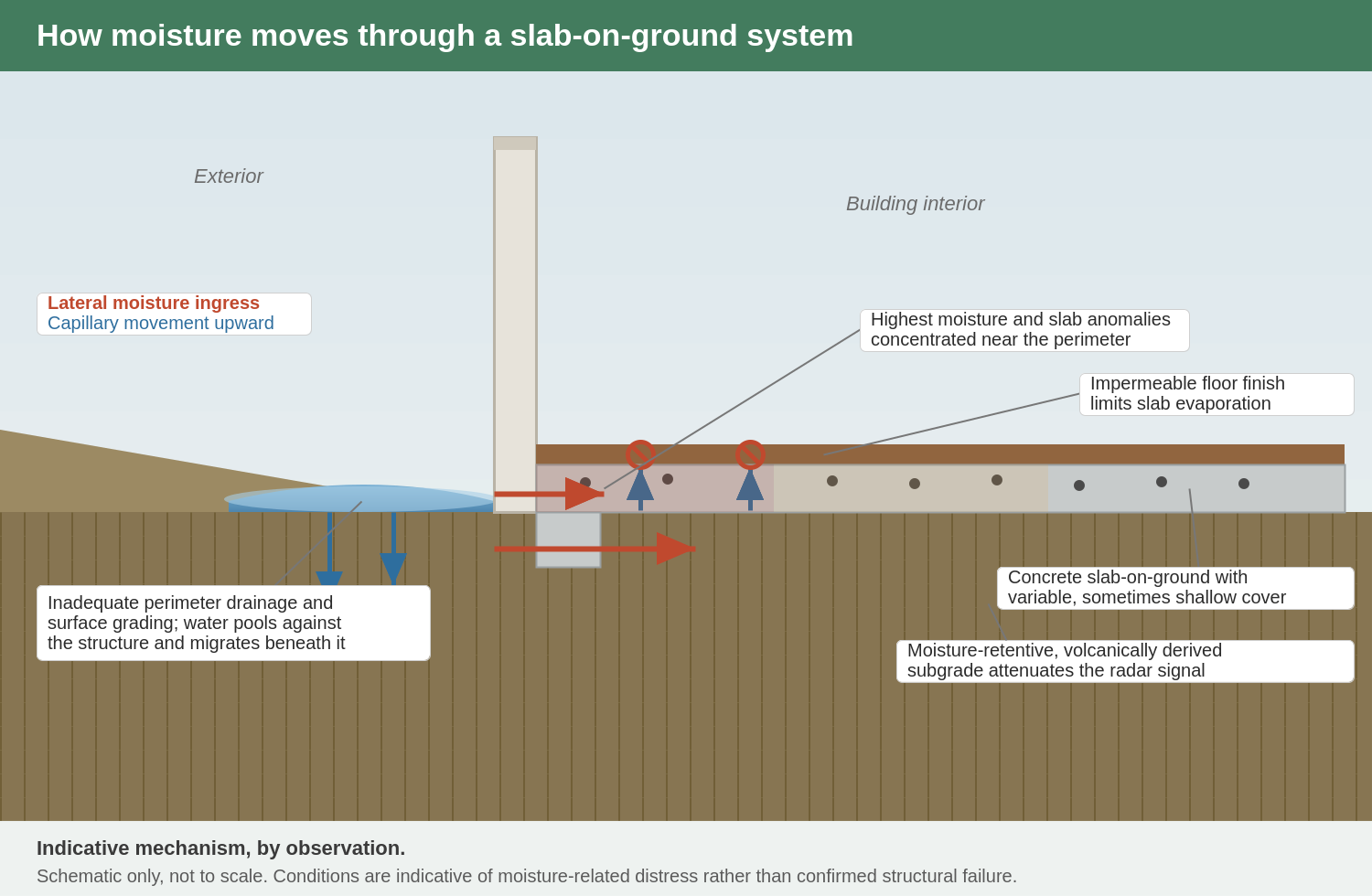
Moisture typically enters at the perimeter and migrates laterally and upward through the slab, with floor coverings limiting evaporation from the top surface.
On this site, surface moisture testing using a Tramex CMEX5 impedance meter returned readings generally between 4.0% and 5.5% across most locations, with localised peaks above 6.0%. Readings were consistently higher near the building perimeter and lower toward internal zones — a pattern consistent with lateral moisture ingress from outside rather than a single internal source.
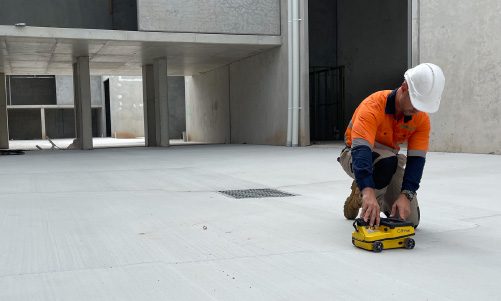
Ground-penetrating radar, run with a Proceq GP8000 across seven discrete locations at scan spacings of 50 mm to 100 mm, added the layer moisture testing can't provide on its own: what the slab actually looks like beneath the surface. Reinforcement cover, depth, and any irregularities below the rebar layer were mapped using both B-scan and depth-slice (C-scan) data, then cross-checked against Profometer PM8000 readings for added confidence in cover depth.
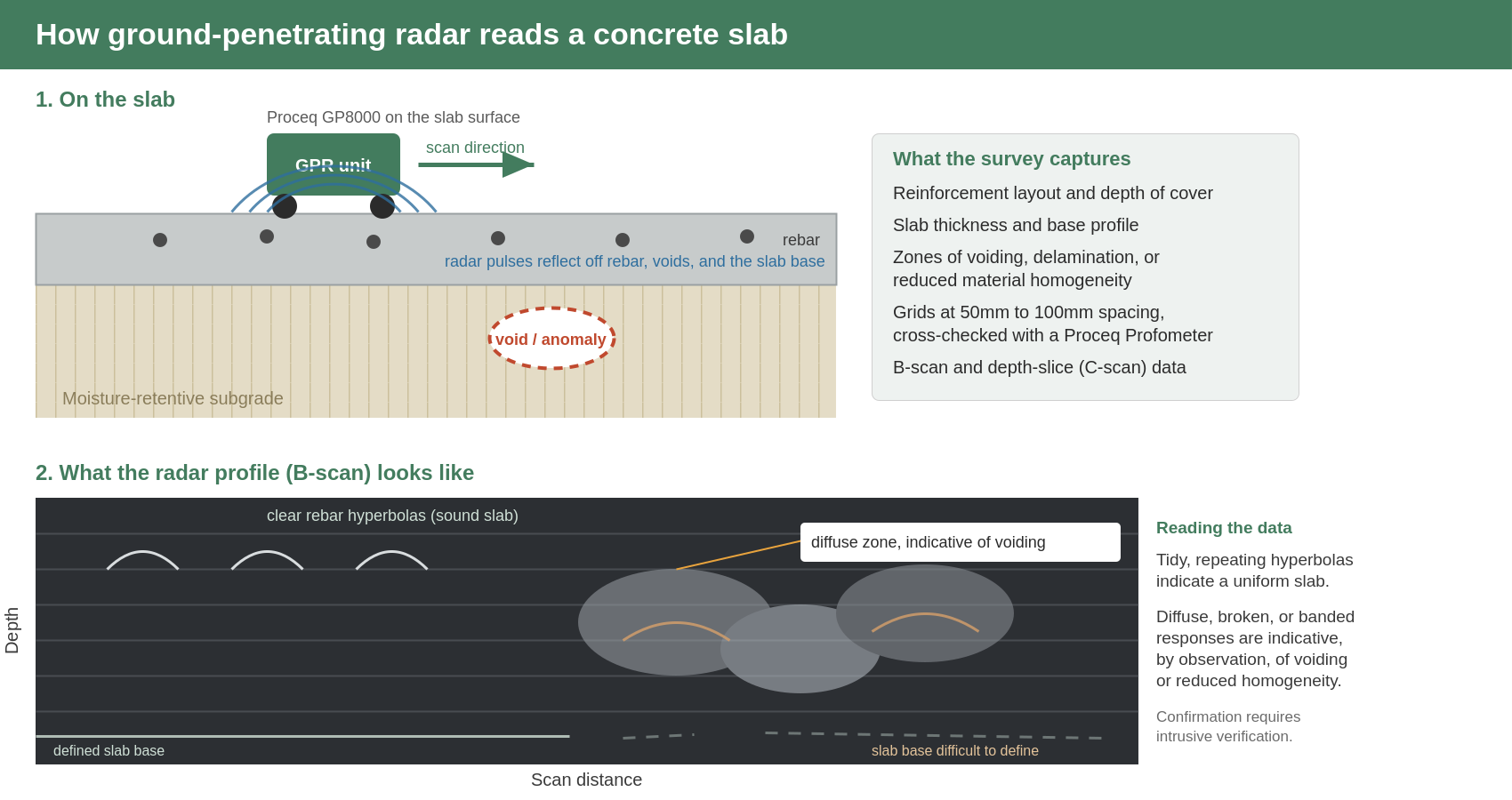 How Ground-Penetrating Radar Reads A Concrete Slab
GPR sends electromagnetic pulses into the slab and interprets the reflections that bounce back from reinforcement, voids, and material inconsistencies — without any need to break the surface.
What The Combined Data Showed
Across the seven investigation areas, the GPR data was consistently more irregular than what you'd expect from a sound slab-on-ground system. Rather than clean, uniform reflections, the scans showed diffuse responses, inconsistent reinforcement cover, and pronounced banding beneath the rebar layer in several locations — patterns consistent with localised voiding, possible honeycombing, and reduced material homogeneity. In a number of areas, the bottom of the slab itself was difficult to define clearly.
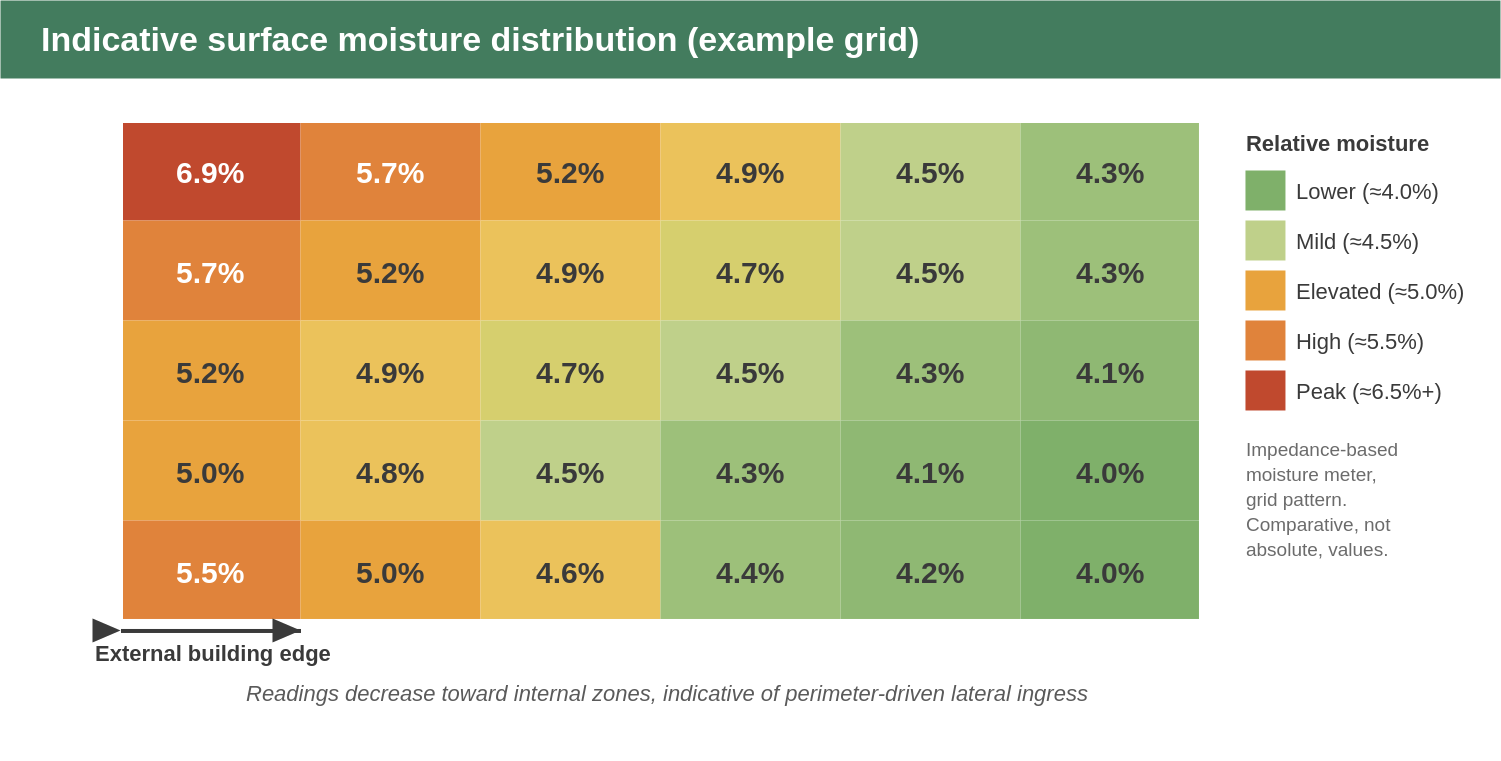 Indicative Surface Moisture Distribution Grid
Grid-based moisture readings allowed gradients to be mapped across each location, helping distinguish perimeter ingress from genuinely isolated trouble spots.
Three locations stood out as the most significant areas of concern:
It would have been easy to assume moisture-related distress was confined to the building's edges. The Centre Area result showed that wasn't the case here — a reminder that perimeter drainage issues don't automatically explain every anomaly found further inside a slab.
Drainage, Floor Coverings, And The Norfolk Island Factor
The investigation didn't stop at the slab. A visual inspection of the external perimeter found evidence of inadequate drainage, including water pooling against the building and efflorescence on external slab surfaces — a visible sign of ongoing moisture movement through the concrete. Internally, a combination of carpet and floating floor finishes was found to be limiting evaporation from the slab surface, almost certainly contributing to the long-term mould issues reported on site.
Norfolk Island's geology added another layer of context. The island's volcanically derived soils, formed from weathered basalt and ash, are naturally moisture-retentive and prone to variable density and shrink-swell behaviour depending on drainage and weathering. Prolonged moisture ingress into soils like these can soften near-surface subgrade material and contribute to differential slab movement over time — and the same moisture-retentive ground also increases GPR signal attenuation, which helps explain some of the diffuse, inconsistent reflections recorded across the site.
From Findings To A Clear Set Of Recommendations
The most useful outcome of a non-destructive investigation isn't a verdict — it's direction. GPR and moisture testing are indirect indicators; they identify patterns and anomalies reliably, but confirming the exact nature of a defect requires intrusive investigation where greater certainty is needed. That distinction shaped every recommendation in this report.
Importantly, the data did not point to catastrophic or uniform slab failure. The anomalies were significant enough to act on, but localised and variable in severity rather than systemic — meaning full slab replacement could not be justified on the non-destructive data alone.
- Fix the drainage first. Surface grading, downpipes, and perimeter drainage around the building should be reviewed and corrected before any internal treatment is considered. Concrete treatments achieve little while water keeps gathering against the slab edge.
- Target intrusive verification at three locations. Core drilling or localised breakout was recommended specifically at the Front Office, North Corner, and Centre Area to confirm slab thickness, underside condition, and the presence of any voiding or delamination.
- Bring in a structural engineer. A suitably qualified engineer or remediation consultant should review the cracking, moisture readings, and GPR findings together to determine whether remediation or ongoing monitoring is the right path.
- Reconsider the floor coverings. Lifting impermeable finishes in the worst-affected areas would allow further inspection and let the slab actually dry out, rather than staying sealed under carpet and floating floors.
- Monitor what's left. Areas with active cracking or elevated moisture should be checked periodically for further movement or migration, rather than treated as resolved once the report lands.
Why This Matters
It's tempting to treat a cracked, mouldy slab as a binary problem — rip it out, or ignore it. The value of combining GPR with moisture mapping is that it replaces that guesswork with a graded picture: which areas are genuinely concerning, which are moderate and worth watching, and which findings are best explained by something as ordinary as poor drainage. For Norfolk Island Regional Council, that meant a clear, prioritised path forward — drainage corrections, three targeted intrusive checks, and an engineering review — instead of a costly, all-or-nothing decision made on incomplete information.
Frequently Asked Questions
GPR doesn't measure moisture content directly, but moisture changes how radar signals travel through concrete and the ground beneath it. Combined with a dedicated surface moisture meter, GPR helps explain why moisture is appearing where it is by revealing reinforcement cover, voids, and subsurface inconsistencies that moisture readings alone can't show.
No. On this site, the non-destructive data showed localised and variable distress rather than uniform or catastrophic failure, so full slab replacement could not be justified with confidence from the GPR and moisture data alone. Targeted intrusive investigation in the worst-affected areas was recommended before any major replacement decision.
Most of the elevated moisture readings on this site were concentrated near the building perimeter, consistent with water entering laterally from outside rather than rising evenly from below. Poor surface grading and inadequate drainage infrastructure were observed during the external inspection, and correcting that is a precondition for any internal treatment having a lasting effect.
Yes. Carpet and floating floor finishes can limit evaporation from the slab surface, trapping moisture within the concrete rather than letting it dissipate. This was identified as a likely contributing factor to the recurring mould reported at this site.
GPR and moisture testing are non-destructive and provide indirect indicators of subsurface conditions. They're reliable for identifying patterns and anomalies, but confirming the specific nature of a defect — such as voiding, delamination, or subgrade loss — requires intrusive methods like core drilling or localised breakout where greater certainty is needed before a remediation decision is made.