Ground Penetrating Radar (GPR) lets you see what's inside concrete, or under the ground, without cutting, coring or digging. Instead of working blind, you get the location and depth of rebar, post-tension cables, conduits, pipes and voids before the work starts. Here's what GPR is, what it can find, its main benefits and its honest limitations, with an example from one of our own projects.
What is ground penetrating radar?
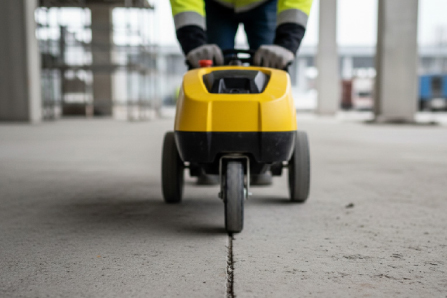
GPR sends high-frequency radar pulses into a material such as concrete, soil or asphalt. When a pulse meets something with different properties, like steel, plastic pipe, air or water, part of it reflects back to the scanner.
Those reflections are processed into a picture of what's below the surface, in real time. Our specialists interpret the data and mark the location of each object directly on the surface, so you can start work straight away.
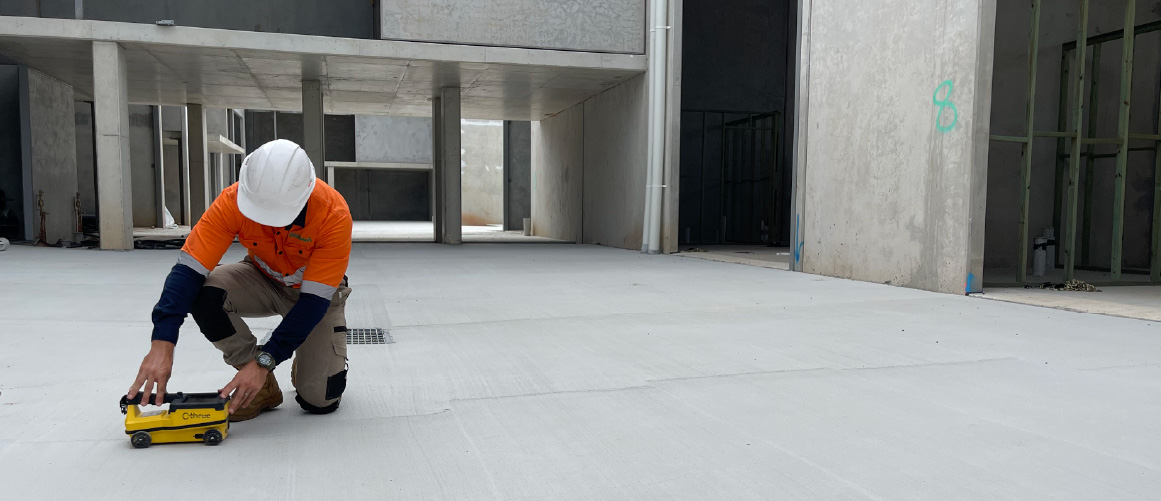
GPR has been in development since the 1930s, and advances in the technology have made it far more affordable and accessible. Modern units are compact enough to carry on site with little set-up time, and they scan floors, walls and ceilings, so a whole room can be checked if needed.
What GPR can find
Reinforcement
Rebar, mesh and post-tension cables, so drilling and coring avoid them.
Services
Electrical conduits, pipes and ducts, metallic and non-metallic.
Voids and defects
Voids under slabs and pavements, plus honeycombing and delamination inside the concrete.
Thickness and cover
Slab thickness and the concrete cover over reinforcement.
Below ground, GPR also helps assess ground conditions and locate buried objects without invasive digging. Read more about our ground penetrating radar services.
The benefits of GPR
Non-destructive
There's no drilling, coring or excavation to find out what's there, so the structure stays intact. That makes GPR well suited to occupied buildings, public spaces and sensitive sites, and there is nothing to clean up afterwards.
Accurate
Modern systems with 3D modelling show the position and depth of embedded objects precisely. Accuracy depends on calibration and an experienced operator, which is why we verify results on site (see the example below).
Real-time results
Data is collected and interpreted on site, so decisions can be made straight away instead of waiting on off-site analysis.
Safer work
Identifying post-tension cables, live conduits and voids in advance means hazards are dealt with before anyone cuts, cores or digs.
Cost-effective
Avoiding one service strike, redesign or round of rework usually saves far more than the scan costs.
Versatile
The same technology works on concrete, soil and asphalt, across construction, civil engineering, geotechnical investigations and heritage sites.
Clear records
Reports with visual results help everyone from engineers to subcontractors understand the findings, and the data can be archived for compliance and maintenance planning.
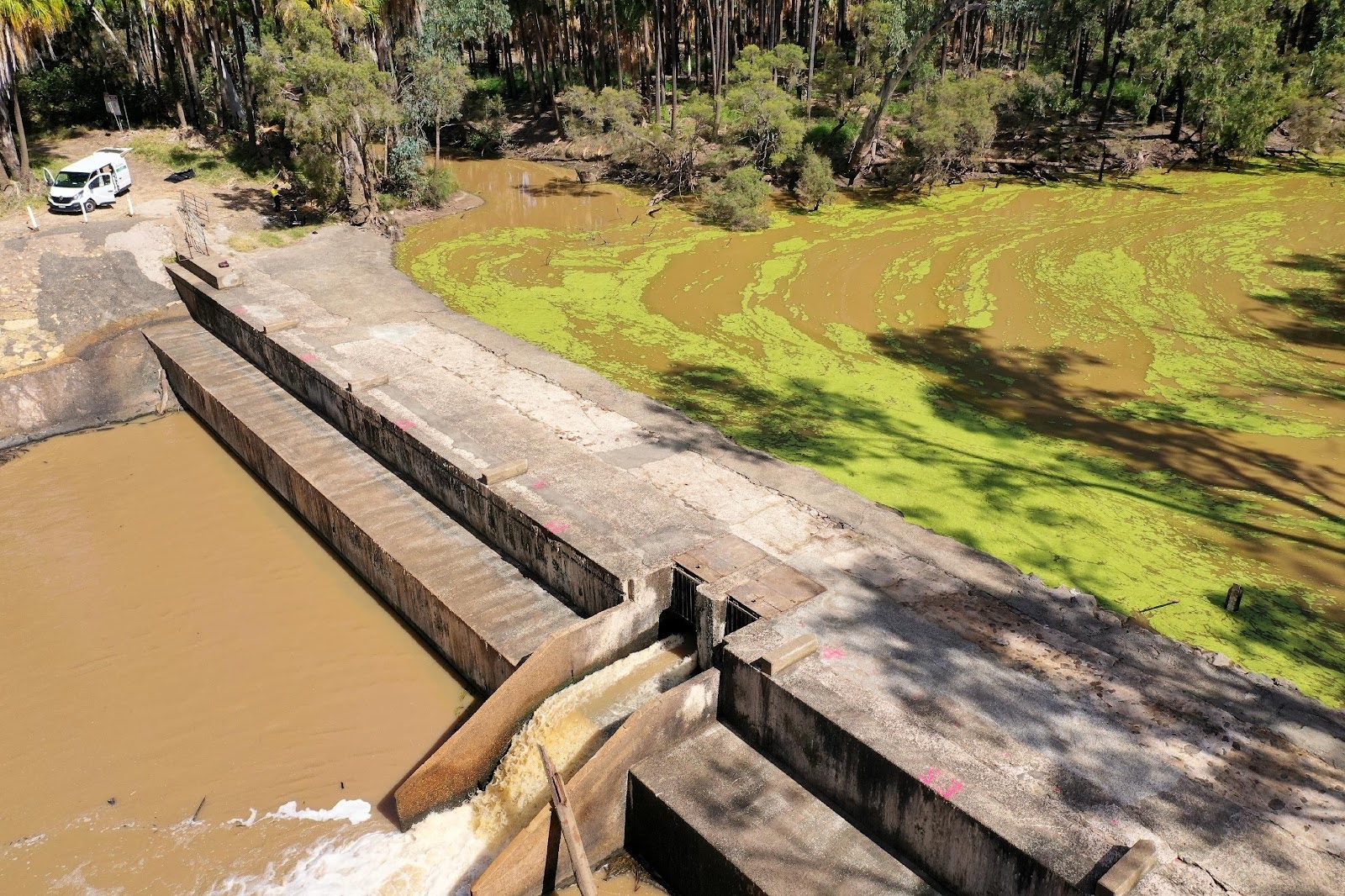
Case study: Tanawah Reservoir, Sunshine Coast
Confirming 50mm of concrete cover with a Proceq GP8000
Advanced Concrete Engineering needed post-tension cable "onions" located in a tilt-panel slab at a UnityWater tank, and at least 50mm of concrete cover confirmed to meet the engineering specifications.
Before scanning, we calibrated the GP8000 on site with a third party observing: we measured the cover physically with a tape measure, scanned the same reinforcement and confirmed the results matched. The survey then confirmed at least 50mm of cover throughout, which helped secure engineering approval and avoid costly redesigns.

GPR goes well beyond slabs, too. We've used it to examine a 1980s water reservoir in Lowood with no construction plans available, to search for abandoned mineshafts under roads near Coober Pedy, and to locate unmarked graves on a development site for the Cherbourg Aboriginal Shire Council. See more in our case studies.
The limitations to know about
GPR is powerful, but it isn't a silver bullet. Being upfront about its limits is part of getting reliable results.
- Interpretation takes skill. Reading GPR data means telling different materials and structures apart, which comes from experience.
- Site conditions matter. Moisture, soil composition and the type of concrete or pipe material can add "noise" and affect how far the signal penetrates.
- Depth has limits. Every system has a practical depth and accuracy range, so set expectations with your provider before the scan.
Getting the best results from a GPR scan
- Define what you need to find, whether that's voids, reinforcement or services, so the scan is focused.
- Prepare the site by clearing obstacles and debris from the scan area.
- Talk through the materials and conditions with your provider so the equipment is set up for them.
- Build the results into your plan for cutting, drilling or excavation.
- Consider follow-up scans on large or complex projects to confirm findings before work proceeds.
For concrete specifically, our guide on why concrete scanning is important before cutting or coring covers when to scan and what skipping it costs.
GPR FAQs
What are the benefits of ground penetrating radar?
It's non-destructive, accurate, gives real-time results on site, improves safety, saves money by preventing strikes and rework, works on many materials and produces clear records for your project.
Does GPR damage the concrete?
No. GPR scans from the surface using radar pulses, so nothing is cut, cored or drilled to get the information.
Can GPR detect plastic pipes?
Yes. Unlike methods that only detect metal, GPR picks up both metallic and non-metallic objects, including plastic pipes and conduits.
Can GPR scan walls and ceilings?
Yes. GPR isn't limited to floors. Walls and ceilings can be scanned too, so a whole room can be checked if needed.
What affects GPR accuracy?
Calibration, operator experience and site conditions such as moisture, soil composition and material type. That's why we calibrate on site and have experienced technicians interpret the data.
Find out what's below before you start
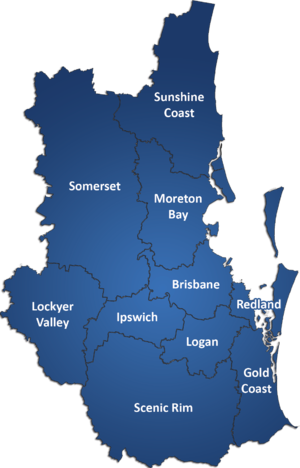
South East Scanning provides accurate GPR scanning across South East Queensland and beyond, with clear site markings and reports your team can act on.